

Global Capacitor Grade BOPP Films Market Size to Grow from US$874.53 Million in 2025 to US$1,336.23 Million by 2032
Capacitor Grade BOPP Films Market Research Report 2026
Capacitor Grade BOPP Films Market to Reach US$1.34 Billion by 2032 as EVs, Renewable Energy and Power Electronics Drive Demand
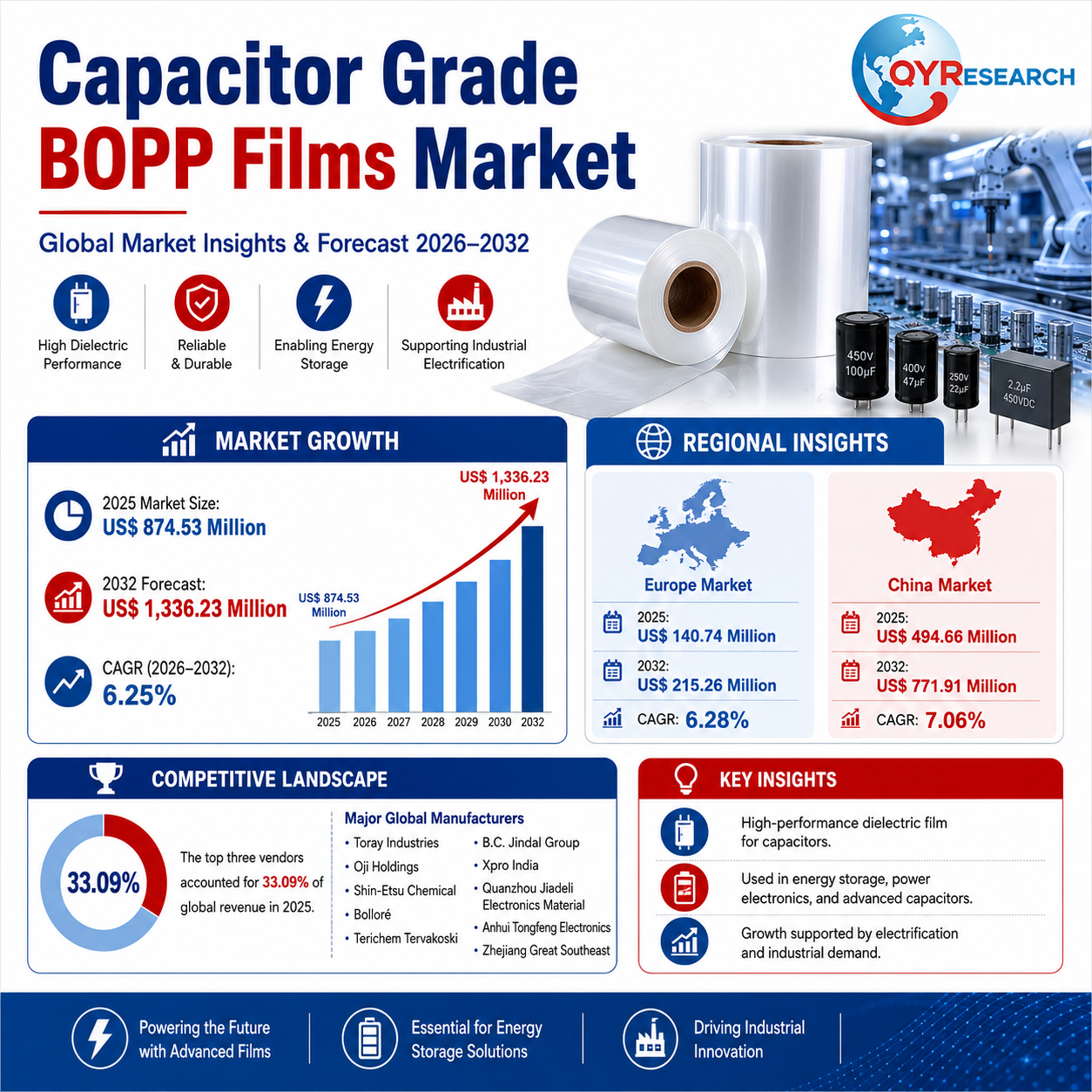
PUNE, MAHARASHTRA, INDIA, August 31, 2026 /EINPresswire.com/ -- The global Capacitor Grade BOPP Films Market is entering a steady expansion phase as demand for high-performance film capacitors increases across electric vehicles, renewable energy systems, energy storage, industrial power electronics, household appliances and grid infrastructure. The global market was valued at approximately US$874.53 million in 2025 and is projected to reach approximately US$1,336.23 million by 2032, expanding at a CAGR of 6.25% during 2026-2032.China remains the most important regional market and is projected to expand from US$494.66 million in 2025 to US$771.91 million by 2032, representing a CAGR of approximately 7.06%. Europe is expected to increase from US$140.74 million in 2025 to US$215.26 million by 2032, growing at approximately 6.28% CAGR. Future competition will increasingly center on ultra-thin film manufacturing, dielectric strength, thickness uniformity, heat resistance, production yield, metallization compatibility, cost control and the ability to meet demanding automotive, renewable-energy and industrial capacitor specifications.
Download Exclusive Research Report PDF Sample: (Including Full TOC, List of Tables & Figures, Chart) @ https://www.qyresearch.in/request-sample/chemical-material-global-capacitor-grade-bopp-films-market-research-report-2026
Market Overview: A Specialized Film Material Becoming More Important to Electrification
Capacitor Grade BOPP Films are highly specialized biaxially oriented polypropylene films designed primarily for use as dielectric materials in film capacitors. Their electrical insulation properties, dielectric strength, low dielectric loss, thermal stability and ability to support reliable capacitor performance make them important materials within modern electrical and electronic systems. Although capacitor-grade BOPP film represents a relatively specialized segment of the broader plastic film industry, its strategic importance is increasing as electrification expands across transportation, power generation, industrial automation and consumer electronics.
Film capacitors using BOPP dielectric materials are widely used where high reliability, stable electrical characteristics, low losses and long operating life are important. These characteristics make capacitor-grade BOPP films relevant to DC-link capacitors, power electronics, inverter systems, renewable energy equipment, electric vehicles, power grids, industrial equipment and electronic appliances.
Market Key Drivers
One of the strongest growth drivers for the Capacitor Grade BOPP Films market is the rapid expansion of electric vehicles and automotive power electronics. Modern EVs require increasingly sophisticated power conversion systems, including traction inverters, onboard chargers, DC-DC converters and other high-voltage electronic modules. Film capacitors are widely used in many of these systems because of their high ripple-current capability, self-healing characteristics and reliable performance. As vehicle manufacturers move toward higher voltage architectures and increasingly powerful electric drivetrains, capacitor manufacturers face stronger requirements for compact design, thermal stability and high-voltage performance. These trends are increasing demand for thinner, more uniform and higher-performance BOPP films.
Renewable energy is another important demand driver. Solar inverters, wind-power converters and energy-storage systems require reliable power electronic components capable of operating under fluctuating loads and demanding environmental conditions. Film capacitors are widely used for filtering, DC-link applications and power conversion, creating steady demand for capacitor-grade BOPP films. Power-grid modernization is also supporting market development as countries invest in transmission, distribution, smart-grid infrastructure, power-quality equipment and industrial electrification.
Electric Vehicles Create a Higher-Value Growth Opportunity
Automotive applications are becoming increasingly important because they often require higher product reliability and more demanding technical specifications than general-purpose electronics. Capacitor films used in automotive power electronics must maintain electrical and mechanical performance across wide temperature ranges and under demanding voltage conditions. Automotive customers also require strong quality-control systems, consistent production batches, long-term supply stability and extensive qualification processes. These requirements create barriers to entry but can also create stronger customer relationships for qualified suppliers.
The continued expansion of EV production is therefore likely to strengthen demand for high-performance films, particularly thinner grades that help capacitor manufacturers reduce component size while maintaining electrical performance. For film manufacturers, the opportunity is not simply higher volume. The greater strategic opportunity is to develop grades that meet increasingly demanding automotive capacitor specifications and secure long-term supply relationships with capacitor producers and automotive supply chains.
Market Segmentation by Thickness
The Capacitor Grade BOPP Films market is segmented by thickness into ≤3 μm, 3-6 μm, 6-9 μm, 9-12 μm and >12 μm. Thickness is one of the most important commercial and technical parameters in the market because it influences dielectric performance, capacitor size, processing difficulty and final application. The ≤3 μm segment represents one of the most technologically demanding categories. Producing ultra-thin film requires advanced extrusion, stretching, thickness-control and winding technologies.
Even small variations in film uniformity can affect downstream capacitor performance, making manufacturing precision extremely important. The 3-6 μm segment is also significant across high-performance power-electronics applications where manufacturers seek a balance between dielectric performance, mechanical strength and manufacturing economics.
Films in the 6-9 μm and 9-12 μm ranges continue to serve a broad variety of electrical and industrial capacitor applications. Films above 12 μm may be selected for applications where mechanical robustness or specific electrical requirements are prioritized over miniaturization. Through 2032, the competitive advantage of manufacturers is expected to become increasingly linked to their ability to achieve consistent ultra-thin production while maintaining strong yield and electrical performance.
Market Segmentation by Application
The Capacitor Grade BOPP Films market can be divided into Automotive, Renewable Energy and Energy Storage, Power Grid and Industrial Applications, Household Appliances and General Electronics, and other applications. Automotive applications are expected to remain among the most strategically important segments because of EV growth and increasingly sophisticated vehicle power electronics.
Renewable energy and energy storage represent another high-potential application area. Solar power, wind power, battery energy storage and distributed energy systems all require power-conversion equipment containing capacitors. Power grid and industrial applications remain important because film capacitors are used in industrial drives, power-quality systems, frequency converters, grid equipment and other electrical infrastructure. Household appliances and general electronics provide a broad and relatively mature demand base, supporting consumption across motors, power supplies and electronic control systems.
Ultra-Thin Films Are Becoming a Competitive Battleground
One of the most important technology trends in the market is the development of increasingly thin BOPP films. Reducing film thickness allows capacitor manufacturers to increase capacitance density and reduce physical size. This is particularly important in electric vehicles and compact power electronics, where space and weight are valuable. However, reducing thickness significantly increases manufacturing difficulty. Film manufacturers must control resin purity, extrusion stability, stretching conditions, surface defects and thickness variation while maintaining high dielectric strength. Production yield can therefore become an important commercial differentiator. A supplier capable of producing thinner film is not automatically competitive if manufacturing yield is poor or product consistency is insufficient. The most successful suppliers will need to balance thickness reduction with production economics, mechanical stability and customer qualification requirements.
Competitive Landscape
The global Capacitor Grade BOPP Films market includes established Japanese and European materials companies, large Asian film producers and specialized capacitor-film manufacturers.
Major companies include Toray Industries, Oji Holdings, Shin-Etsu Chemical, Bolloré, Terichem Tervakoski, B.C. Jindal Group, Xpro India, Quanzhou Jiadeli Electronics Material, Anhui Tongfeng Electronics, Zhejiang Great Southeast, Hubei Longchen Technical, Hebei Haiwei Electronic New Material Technology, FSPG Hi-Tech and Nantong Bison Electronic New Material.
In 2025, the world's top three suppliers accounted for approximately 33.09% of global revenue, indicating a market with meaningful concentration among leading manufacturers but continued room for regional competitors. Leading suppliers compete on several factors beyond price, including film thickness, dielectric strength, surface uniformity, heat resistance, production scale, manufacturing yield, customer qualification and long-term supply capability. For automotive and renewable-energy applications, product reliability and consistency can be more important than simply offering the lowest price.
China Emerges as the Largest Strategic Growth Market
China is expected to remain one of the most important markets for Capacitor Grade BOPP Films through 2032. The Chinese market was valued at approximately US$494.66 million in 2025 and is projected to reach approximately US$771.91 million by 2032, representing a CAGR of approximately 7.06%. China benefits from a large manufacturing ecosystem covering electric vehicles, charging infrastructure, solar power, wind energy, industrial electronics, capacitor manufacturing and power-grid equipment. The country's extensive downstream supply chain creates significant local demand for capacitor films while also supporting domestic manufacturers in expanding production capabilities.
However, growth in capacity does not necessarily mean that all suppliers will compete successfully in high-end applications. Automotive and advanced power-electronics customers increasingly require stricter quality control, stable film thickness, reliable electrical properties and long qualification cycles. As a result, China's market opportunity will increasingly shift from simply expanding output toward improving product quality and entering higher-value applications.
Europe Maintains Strength in High-Quality Applications
The European Capacitor Grade BOPP Films market is projected to expand from approximately US$140.74 million in 2025 to US$215.26 million by 2032, representing a CAGR of approximately 6.28%. Europe remains an important market because of its established automotive, renewable energy, industrial equipment and electrical infrastructure sectors. The transition toward electric mobility and renewable power generation is supporting long-term demand for film capacitors. European customers may also place increased emphasis on energy efficiency, material traceability, product quality and supply-chain reliability. For suppliers, Europe offers opportunities in premium applications but may require stronger technical support and compliance capabilities.
India and Wider Asia Create New Supply-Chain Opportunities
Beyond China, other parts of Asia are becoming increasingly important to the capacitor-film industry. India is expanding investment in electric mobility, renewable energy, power infrastructure and domestic electronics manufacturing. This creates potential demand for both capacitor components and specialized dielectric films. Manufacturers such as B.C. Jindal Group and Xpro India illustrate the growing relevance of regional film production within the broader Asian supply chain. Southeast Asia may also benefit from diversification in electronics manufacturing and renewable-energy investment. For global suppliers, localized manufacturing, distribution and technical support could become increasingly important as downstream customers seek shorter supply chains and reduced dependence on distant suppliers.
Industry Challenges
The Capacitor Grade BOPP Films industry faces several important challenges. The first is the technical difficulty of producing ultra-thin films with consistent quality. As thickness decreases, processing windows become narrower and manufacturing yield becomes increasingly difficult to control. A second challenge is raw-material quality and supply stability. Capacitor-grade polypropylene requires extremely high purity and stable characteristics. Variations in raw-material quality can affect electrical properties and production performance. A third challenge is strong pricing pressure. Capacity expansion, particularly in Asia, can increase competition in standard film grades and compress margins. Manufacturers therefore need to move toward higher-value applications rather than relying only on volume growth. Qualification cycles represent another barrier. Automotive, renewable-energy and industrial customers may require extensive testing before approving new materials, making customer acquisition time-consuming and costly.
Market Trends & Dynamics 2026-2032
Between 2026 and 2032, the global Capacitor Grade BOPP Films market is expected to evolve around several major trends. The first is continued film thinning as capacitor manufacturers seek greater energy density and smaller components. The second is higher electrical and thermal performance to support demanding automotive and renewable-energy applications. The third is increased emphasis on production yield and cost optimization. The fourth is greater integration between film manufacturers and downstream capacitor producers during the product-development stage. Suppliers that participate early in customer projects may have stronger opportunities to secure long-term business. Another important trend will be supply-chain localization. Automotive and energy customers increasingly evaluate supply security alongside pricing, creating opportunities for manufacturers with production capacity close to major downstream markets.
Business Opportunities for Manufacturers
For manufacturers, the most attractive opportunities may be found where technical barriers are highest. Ultra-thin films, automotive-grade materials, high-voltage capacitor applications and renewable-energy systems generally require stronger performance and more demanding qualification. These segments can therefore offer more attractive differentiation than commodity film applications. Companies should also evaluate which downstream capacitor customers are expanding capacity, which EV and renewable-energy platforms require new film specifications and where domestic substitution opportunities are emerging. Production investment should be aligned with actual customer demand rather than capacity expansion alone. Manufacturers that improve yield, reduce thickness variation and establish long-term relationships with high-quality capacitor customers are likely to gain stronger competitive positions.
How QYResearch Supports Market Decision-Making
The Capacitor Grade BOPP Films market requires decisions involving technology, capacity, pricing, application selection and customer targeting. QYResearch's market analysis helps manufacturers understand global and regional demand, company rankings, production, average pricing, technology developments and application trends. For existing manufacturers, the research can support capacity expansion, product positioning and competitor benchmarking. For new entrants, it can help evaluate whether attractive opportunities exist in particular thickness ranges or downstream applications. For investors, the study provides insight into which regions and applications are driving growth and how market concentration may evolve. For downstream capacitor manufacturers, the analysis can support supplier evaluation, sourcing strategies and understanding of future material availability.
Key Questions Answered by the Capacitor Grade BOPP Films Market Report
(1) The report examines how large the global Capacitor Grade BOPP Films market could become by 2032 and which regions will generate the strongest growth.
(2) It analyzes which thickness ranges are gaining demand and how the move toward ≤3 μm and other ultra-thin films may influence competition.
(3) The study evaluates how electric vehicles, renewable energy, energy storage and power-grid investment are affecting film consumption.
(4) It also examines the positioning of major manufacturers, market concentration, production levels and average pricing.
Additional questions include which companies are best positioned to serve automotive customers, how China’s growing production capacity may affect global competition, where new capacity should be built and what technical capabilities are required to enter higher-value segments.
Conclusion and Outlook 2026-2032
The global Capacitor Grade BOPP Films market is evolving from a specialized packaging-film derivative into an increasingly strategic material supporting electrification and power electronics. The market is projected to expand from approximately US$874.53 million in 2025 to US$1,336.23 million by 2032, representing a CAGR of 6.25%. China is expected to remain the largest and one of the fastest-growing markets, while Europe continues to provide important demand from automotive, renewable-energy and industrial applications. Over the coming years, competition will increasingly focus on ultra-thin film capability, dielectric performance, production yield, thickness consistency, automotive qualification, supply reliability and cost control.
For manufacturers, simply adding production capacity may not be enough. The companies best positioned for future growth will be those capable of producing increasingly thin and reliable films, controlling manufacturing economics and building close relationships with capacitor producers serving EVs, renewable energy, energy storage and advanced industrial power electronics. For investors, researchers and manufacturers, understanding these technology shifts, capacity developments and downstream demand patterns will be essential for identifying where the strongest opportunities in the Capacitor Grade BOPP Films market will emerge through 2032.
For Further insights and Detailed Reports, Visit: https://www.qyresearch.in/report-details/7392610/Global-Capacitor-Grade-BOPP-Films-Market
About QYResearch
QYResearch founded in California, USA in 2007.It is a leading global market research and consulting company. With over 17 years’ experience and professional research team in various cities over the world QY Research focuses on management consulting, database and seminar services, IPO consulting (data is widely cited in prospectuses, annual reports and presentations), industry chain research and customized research to help our clients in providing non-linear revenue model and make them successful. We
Contact US
Ankit Jain - Director, Global Digital Marketing
QY Research, INC.
India Office -
315Work Avenue, Raheja Woods, Kalyani Nagar,
Pune, Maharashtra 411006, India
Web – https://www.qyresearch.in
Email- ankit@qyresearch.com
Ankit Jain
QY Research India
+91 81497 36330
ankit@qyresearch.com
Legal Disclaimer:
EIN Presswire provides this news content "as is" without warranty of any kind. We do not accept any responsibility or liability for the accuracy, content, images, videos, licenses, completeness, legality, or reliability of the information contained in this article. If you have any complaints or copyright issues related to this article, kindly contact the author above.
